Sunday, November 9, 2014

Chapter 5: Managing Knowledge and Data


In these post I will highlight the most important point in every section of chapter five


5.1 Managing Data


Difficulties in managing data:


• Amount of data increasing exponentially

• Data are scattered throughout organizations and collected by many individuals   using various methods and devices.

• Data come from many sources.

• Data security, quality, and integrity are critical.


Data governance: is an approach to managing information across an entire organization.

Master data management: is a process that spans all of an organization’s business processes and applications.

Master data: are a set of core data that span all of an enterprise’s information systems.


5.2 The Database Approach


*Database management system (DBMS) minimizes the following problems:


Data redundancy: The same data are stored in many places.

Data isolation: Applications cannot access data associated with other applications.

Data inconsistency: Various copies of the data do not agree.


*DBMS's maximize the following issues:

Data security: Keeping the organization’s data safe from theft, modification, and/or destruction.

Data integrity: Data must meet constraints (e.g., student grade point averages cannot be negative).

Data independence: Applications and data are independent of one another. Applications and data are not linked to each other, meaning that applications are able to access the same data.


*Data Hierarchy:

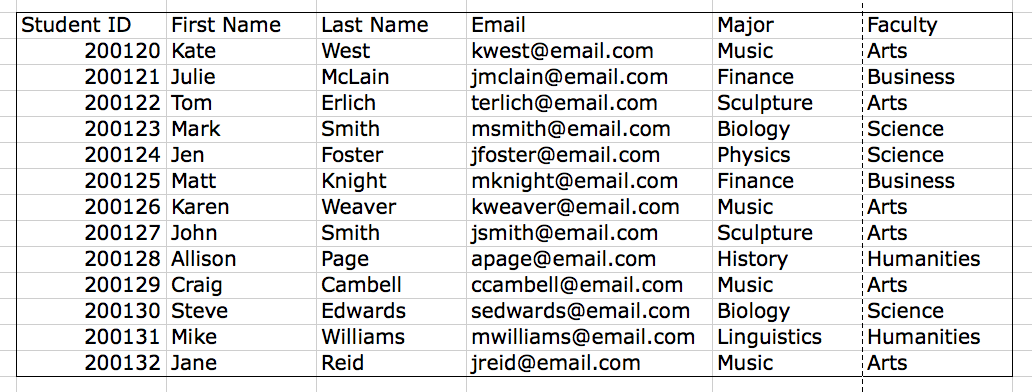
A bit is a binary digit, or a “0” or a “1”.

A byte is eight bits and represents a single character (e.g., a letter, number or symbol).

A field is a group of logically related characters (e.g., a word, small group of words, or identification number).

A record is a group of logically related fields (e.g., student in a university database).

A file is a group of logically related records.

A database is a group of logically related files.


*Designing the Database:


Data model: The data model is a diagram that represents the entities in the database and their relationships.

Entity: An entity is a person, place, thing, or event about which information is maintained. A record generally describes an entity.

Attribute: An attribute is a particular characteristic or quality of a particular entity.

Primary key: The primary key is a field that uniquely identifies a record.

Secondary keys: Secondary keys are other field that have some identifying information but typically do not identify the file with complete accuracy.


*Entity-Relationship Modeling:

Database designers plan the database design in a process called entity-relationship (ER) modeling. ER diagrams consist of entities, attributes and relationships.

Entity classes: Entity classes are groups of entities of a certain type.

Instance: An instance of an entity class is the representation of a particular entity.

Identifiers: Entity instances have identifiers, which are attributes that are unique to that entity instance.


5.3 Database Management Systems


Database management system (DBMS): A database management system is a set of programs that provide users with tools to add, delete, access, and analyze data stored in one location


Relational database model: The relational database model is based on the concept of two-dimensional tables:


  • Structured Query Language (SQL): Structured query language allows users to perform complicated searches by using relatively simple statements or keywords.
  • Query by Example (QBE): Query by example allows users to fill out a grid or template to construct a sample or description of the data he or she wants.


*Normalization:

Normalization is a method for analyzing and reducing a relational database to its most streamlined form for:


  • Minimum redundancy
  • Maximum data integrity
  • Best processing performance


Normalized data occurs when attributes in the table depend only on the primary key.


5.4 Data Warehousing


Data warehouses and Data Marts: A data warehouse is a repository of historical data organized by subject to support decision makers in the organization.


Benefits of Data Warehousing


  • End users can access data quickly and easily via Web browsers because they are located in one place.
  • End users can conduct extensive analysis with data in ways that may not have been possible before.
  • End users have a consolidated view of organizational data.


5.5 Knowledge Management


Knowledge management (KM): Knowledge management is a process that helps organizations manipulates important knowledge that is part of the organization’s memory, usually in an unstructured format.


Knowledge: Knowledge that is contextual, relevant, and actionable.


Intellectual capital (or intellectual assets): Intellectual capital is another term often used for knowledge.


*Type of knowledge:


Explicit knowledge: objective, rational, technical knowledge that has been documented. Examples: policies, procedural guides, reports, products, strategies, goals, core competencies


Tacit knowledge: cumulative store of subjective or experiential learning. Examples: experiences, insights, expertise, know-how, trade secrets, understanding, skill sets, and learning


*Knowledge Management System Cycle:


  • Create knowledge
  • Capture knowledge
  • Refine knowledge
  • Store knowledge
  • Manage knowledge
  • Disseminate knowledge

Friday, November 7, 2014

Chapter 2: Information Systems and the Modern Organization

In these post I will highlight the most important point in every section of chapter two


 2.1 Business Processes

    
  •  A business process is a collection of related activities that produce a product or a service of value to the organization, its business partners, and/or its customers.
  •   A cross-functional business process is one in which no single functional area is responsible for its execution.   


2.2 Business Process Reengineering and Business Process Management


  •      Business process reengineering is a radical redesign of a business process that improves its efficiency and effectiveness, often by beginning with a “clean sheet.”

  •      Business process management is a management technique that includes methods and tools to support the design, analysis, implementation, management, and optimization of business processes.


2.3 Business Pressures, Organizational Responses, and IT Support

Business Pressure - The business environment is the combination of social, legal, economic, physical, and political factors that affect business activities. Significant changes in any of these factors are likely to create business pressure on the organization.

The three types of business pressures faced are:
  •        Market
o   The Global Economy and Strong Competition

o   The Changing Nature of the Workforce

o   Powerful Customers

  •       Technology
o   Technological Innovation and Obsolescence

o   Information Overload

  •   Societal pressures
o   Social Responsibility

o   Government Regulation and Deregulation

o   Protection Against Terrorist Attacks

o   Ethical Issues


2.4 Competitive Advantage and  Strategic Information Systems

  • Competitive Advantage: An advantage over competitors in some measure such as cost, quality, or speed, leads to control of a market and to larger- than average profits.

  • Strategic Information Systems (SIS) provides a competitive advantage by helping an organization to implement its strategic goals and to increase its performance and productivity.


*Porter’s Competitive Forces Model

  • Threat of entry of new competitors is high when it is easy to enter a market and low when significant barriers to entry exist. 
  •   A barrier to entry is a product or service feature that customers expect from organizations in a certain industry. 
  • For most organizations, the Internet increases the threat that new competitors will enter a market.
  •  The bargaining power of suppliers is high when buyers have few choices and low when buyers have many choices.
  •   Internet impact is mixed.  Buyers can find alternative suppliers and compare prices more easily, reducing power of suppliers.
  •  On the other hand, as companies use the Internet to integrate their supply chains, suppliers can lock in customers.
  •  The bargaining power of buyers is high when buyers have many choices and low when buyers have few choices.
  •   Internet increases buyers’ access to information, increasing buyer power.
  •  Internet reduces switching costs, which are the costs, in money and time, to buy elsewhere.  This also increases buyer power.

  • The threat of substitute products or services is high when there are many substitutes for an organization’s products or services and low where there are few substitutes.
  • Information-based industries are in the greatest danger from this threat (e.g., music, books, software).  The Internet can convey digital information quickly and efficiently.
  • The rivalry among firms in an industry is high when there is fierce competition and low when there is not.


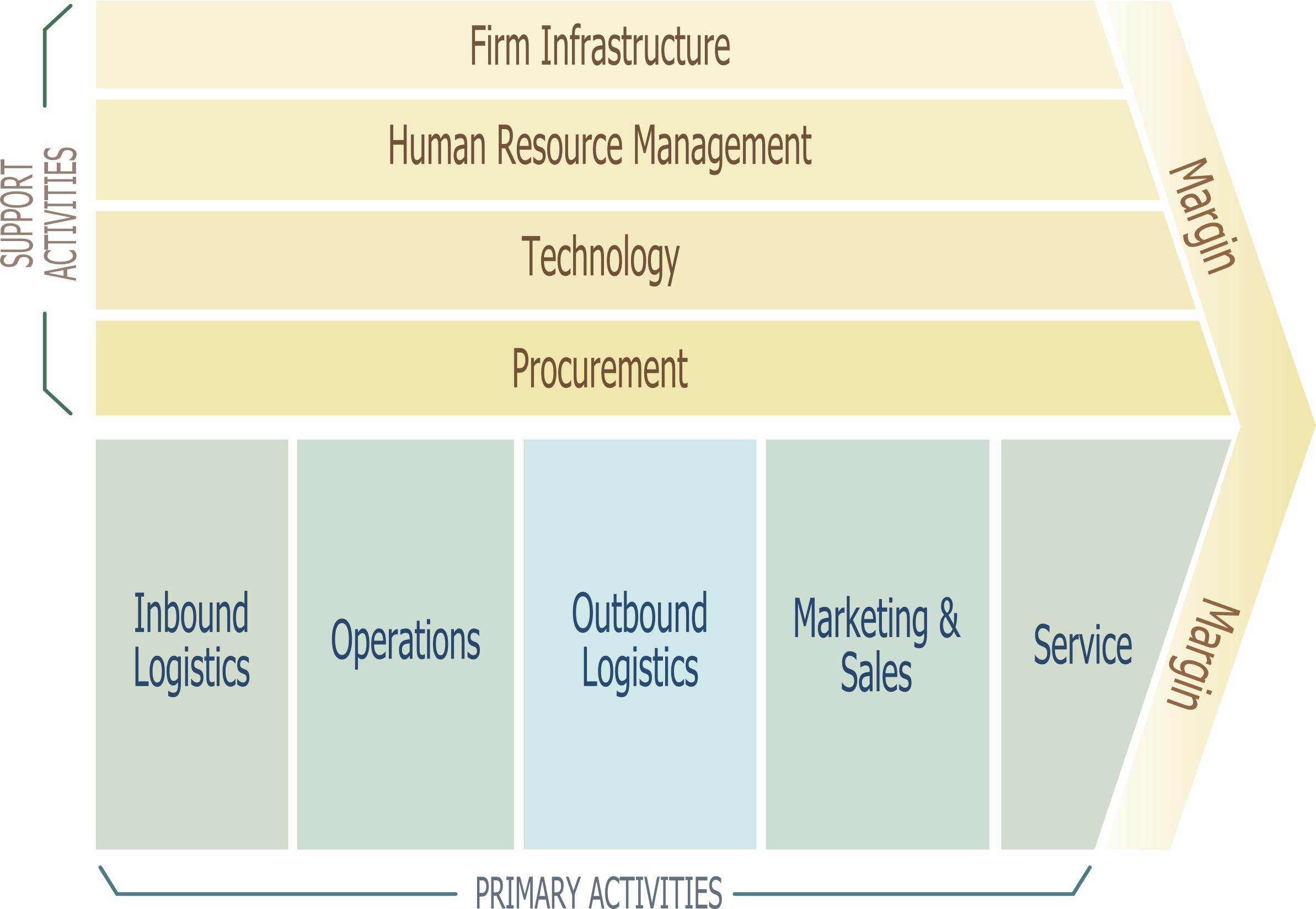
*Porter’s Value Chain Model

This model identifies specific activities where organizations can use competitive strategies for greatest impact.
·        
  •  Primary activities are those business activities that relate to the production and distribution of the firm’s products and services, thus creating value for which customers are willing to pay.  Primary activities include inbound logistics, operations, outbound logistics, marketing and sales, and customer service.
  •   Support activities do not add value directly to a firm’s products and services, but support the primary activities.  Support activities include accounting, finance, management, human resources management, product and technology development (R&D), and procurement.


*Strategies for Competitive Advantage

  • Cost Leadership: Produce products and/or services at the lowest cost in the industry.
  • Differentiation: Offer different products, services or product features.
  • Innovation: Introduce new products and services, add new features to existing products and services or develop new ways to produce them.
  • Operational Effectiveness: Improve the manner in which internal business processes are executed so that a firm performs similar activities better than its rivals.
  • Customer-orientation: Concentrate on making customers happy.

Monday, November 3, 2014

Chapter 1: The Modern Organization Functioning in a Global Environment


In these post I will highlight the most important point in every section of chapter one 


1.1 Why Should I Study Information Systems?
   
 *The Informed User – You!


  •     You are the most connected generation in history.
  •     You practice continuous computing. 
  •     You are surrounded by a personal, movable information network. 
  •     You can pull information from the Web and push your ideas back to the Web.

What is an Information System?


1.2 Overview of Computer-Based Information Systems

Data Item. Elementary description of things, events, activities and transactions that are recorded, classified and stored but are not organized to convey any specific meaning.

Information. Data organized so that they have meaning and value to the recipient.


Knowledge. Data and/or information organized and processed to convey understanding, experience, accumulated learning and expertise as they apply to a current problem or activity. 


Computer-based information systems are information systems that use computer technology to perform some or all of their intended tasks.
  • Hardware is a device such as a processor, monitor, keyboard or printer.
  • Software is a program or collection of programs that enable hardware to process data.
  • Database is a collection of related files or tables containing data.
  • Network is a connecting system (wireline or wireless) that permits different computers to share resources.
  • Procedures are the set of instructions about how to combine the above components in order to process information and generate the desired output.
  • People are those individuals who use the hardware and software, interface with it, or use its output.


Types of Information Systems:-


  • Functional area information systems (FAIS): support particular functional areas (HR, Marketing, Manufacturing) in an organization.
  • Enterprise resource planning (ERP) systems: tightly integrate the functional area information systems via a common database
  • Transaction processing systems (TPS): support the monitoring, collection, storage, and processing (real time) of data from the organization’s basic business transactions.
  • Interorganizational information systems: connect two or more organizations.
  • Office automation systems (OAS): support the clerical staff, lower and middle managers, and knowledge workers. These people use OASs to development documents, schedule resources, and communicate.
  • Business intelligence systems (BI): provide computer-based support for complex, non-routine systems, primarily for middle managers and knowledge workers.
  • Expert Systems: attempt to duplicate the work of human experts by applying reasoning capabilities, knowledge, and expertise within a specific domain.
  • Dashboards: support all managers by providing rapid access to timely information and direct access to structured information in the form of reports.


1.3 How Does IT Impact Organizations?


  • IT reduces the number of middle managers.
  • IT changes the manager’s job.
  • IT impacts employees at work.


1.4  Importance of Information Systems to Society


  • IT Affects Our Quality of Life
  • Robot Revolution on the Way
  • Improvements in Healthcare